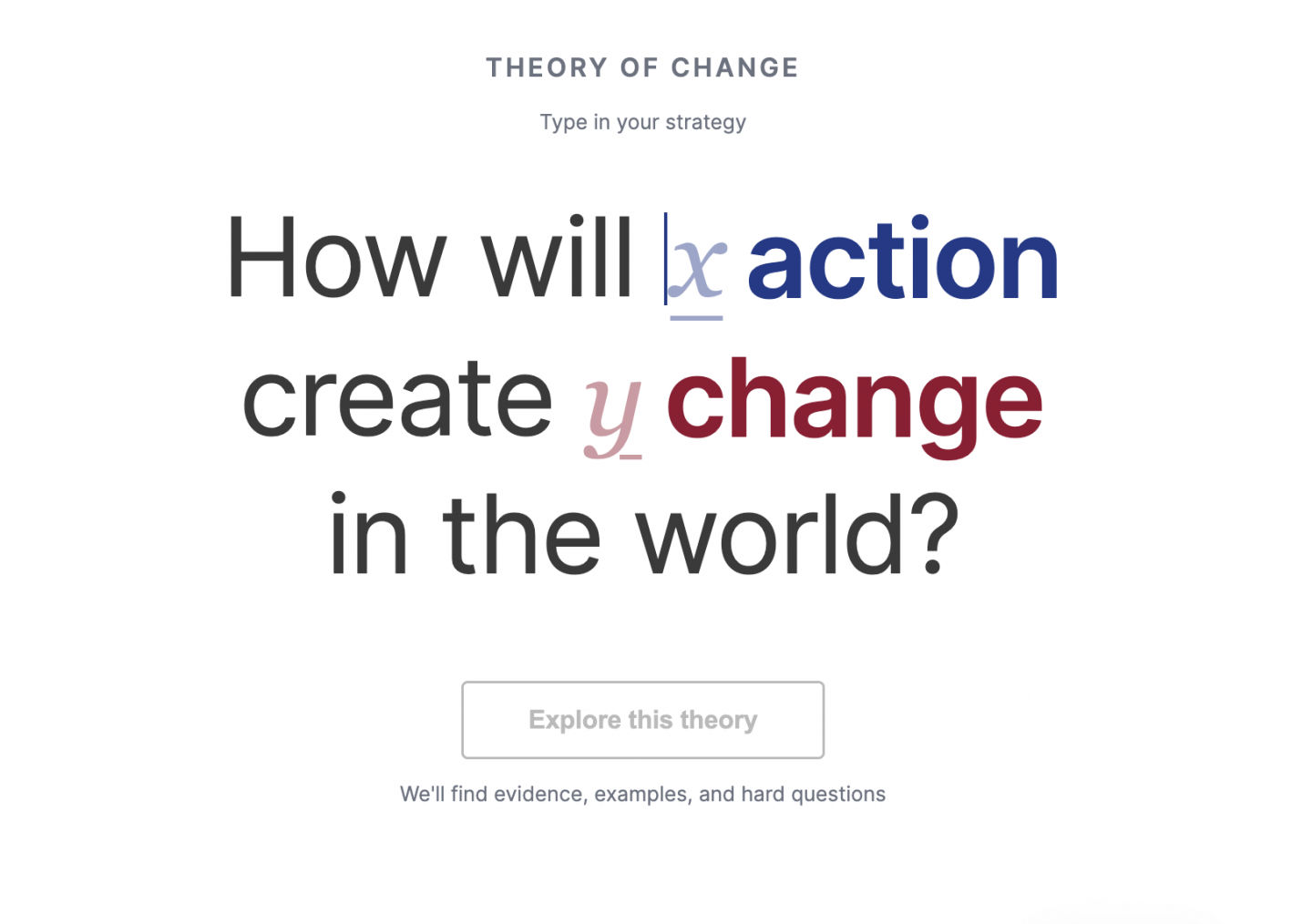
The Theory of Change Explorer allows users to type in a planned action and an intended outcome, and generates an analysis of the causal link between the two.
The analysis is generated using Claude, based on existing evidence available online. It draws on evidence from organising history, maps the assumed steps between action and impact, and surfaces the hidden assumptions embedded in any proposed theory of change. It also connects users to relevant resources within the Civic Tech Field Guide.
Theory of Change as a methodology was developed in the early 1990s by Carol Weiss and colleagues at the Aspen Institute's Roundtable on Community Change, and has since become a cornerstone of civil society planning and evaluation.
The AI-powered Theory of Change tool was developed by Matt Stempeck, head of Democracy & Technology at the Evens Foundation, originally to support graduate students working on political technology projects. It is being made publicly available as a resource for the broader Civil Society community, where theory of change is a widely used planning and evaluation framework. It is also open source, so it can be remixed or redeployed by anyone.
The project follows the Foundation's recent experiment using AI to analyse foresights reports, and is the latest in a series of public experiments exploring how AI tools might serve Civil Society positively in real conditions and in the often-heavy work of promoting and defending democracy in a period of accelerated, extreme change.
It reflects the Foundation’s interest in interrogating what AI can add to society, rather than replace, and shows how AI can support behaviours like self-reflection and critical analysis, not just bypass them.
The Theory of Change Explorer is free to use and requires no registration. A feedback form is built into the tool so users can send direct feedback to the Evens Foundation team and help shape future projects.